
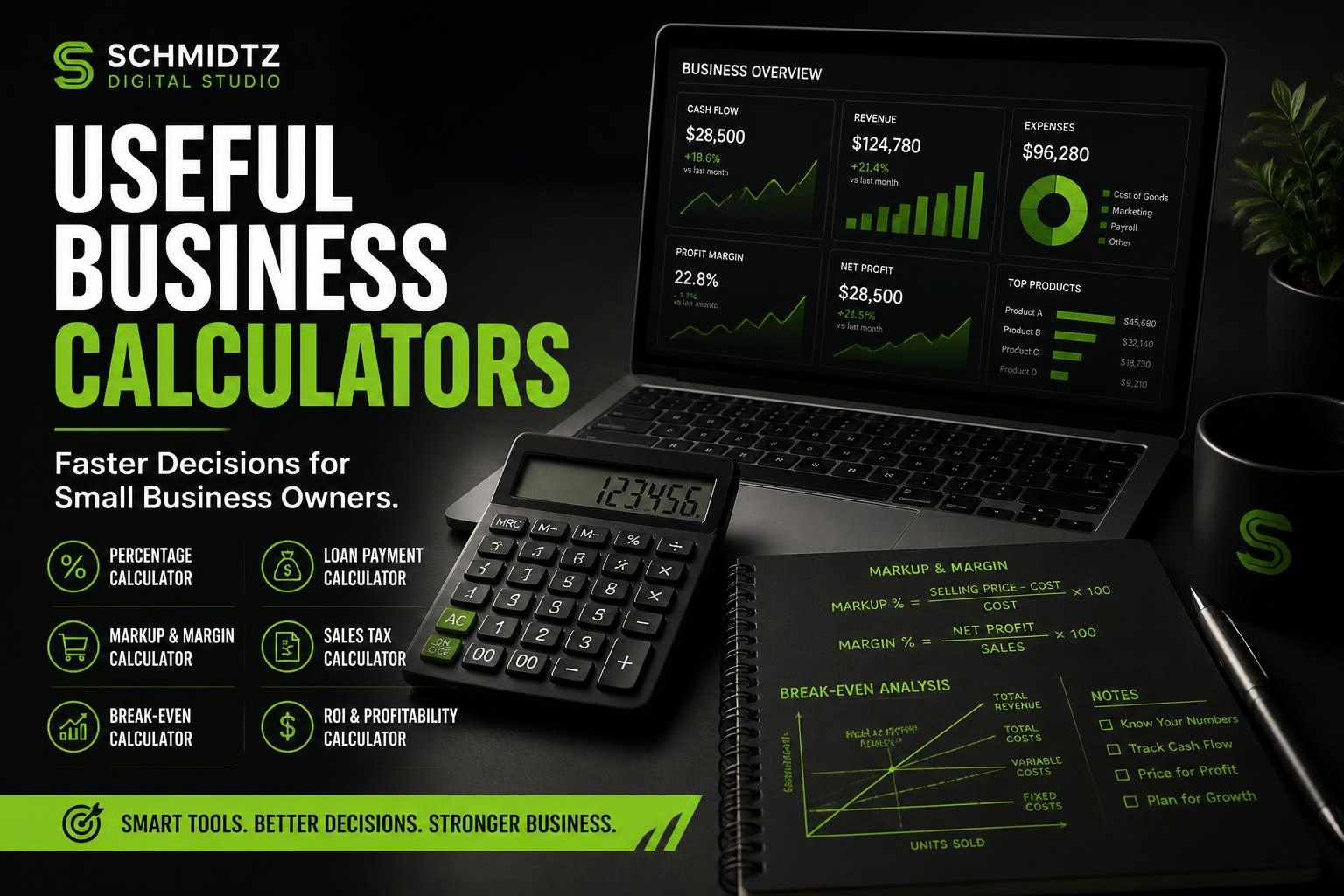
Small-business owners make dozens of small numerical decisions: pricing a job, checking a margin, comparing loan payments, estimating payroll, applying a discount, or figuring out how many sales are needed to cover fixed costs.
You do not need a complicated spreadsheet for every question. A focused calculator can provide a quick answer and help you decide what deserves a deeper look.
1. Markup and margin calculator
Markup and margin are related, but they are not the same thing. Confusing them can lead to pricing that looks profitable but produces less gross profit than expected.
An online Markup & Margin Calculator is useful when setting prices, reviewing product costs, or checking whether a quote leaves enough room for overhead.
2. Break-even calculator
Break-even tells you how much you need to sell before revenue covers the costs being analyzed. It is useful when evaluating a new product, service, campaign, or fixed monthly expense.
The SDS Break-Even Calculator can help turn fixed costs, variable costs, and selling price into a clearer target.
3. Sales tax calculator
A sales tax calculator is useful for quick checks when you know the applicable rate and need to separate the tax from the subtotal or estimate a total.
Tax rules vary by location and situation, so a calculator is not a substitute for professional tax guidance. It is simply a fast arithmetic tool.
4. Loan payment calculator
Before financing equipment or another business purchase, it helps to understand the approximate monthly payment. A Loan Payment Calculator can compare different terms and interest rates before you speak with a lender.
The payment is only part of the decision, but it is an important starting point for cash-flow planning.
5. Hourly-to-salary calculator
When comparing wages, job offers, contractors, or staffing costs, converting an hourly rate into an annualized number can make comparisons easier.
Remember that wages are not the same as total employer cost, but the conversion is still useful for quick planning.
6. Percentage calculator
Percentages appear everywhere in business: price increases, conversion rates, growth, commissions, discounts, and changes in cost. A simple percentage calculator can save time and reduce mental-math errors.
7. Discount calculator
Promotions are easier to evaluate when you can quickly see the sale price and the dollar amount being removed. Before running a discount, pair that number with your margin so you understand the effect on profit.
8. Tip calculator for service scenarios
A tip calculator is mostly an everyday utility, but service-business owners may also use one when checking gratuity examples, event costs, or shared expense scenarios.
9. UTM link builder
Not every useful business “calculator” is about money. A UTM Link Builder helps create trackable campaign links for social posts, email, or promotions so analytics can distinguish where traffic came from.
10. Meta title and description preview
If you manage your own website content, a Meta Title & Description Preview can help you review how search-result copy may fit before publishing.
Calculators are decision aids, not business plans
A calculator can make arithmetic faster, but it only knows the numbers you provide. It does not know your market, cash reserves, tax situation, seasonality, or risk tolerance.
Use calculators to clarify a question, then apply business judgment to the answer.
Keep the tools you use often in one place
SDS maintains a collection of free web tools and business calculators so common tasks do not require installing software or building a spreadsheet from scratch.
If there is a calculation your business performs repeatedly and a generic calculator does not fit, that can also be a good candidate for a small custom tool. Use our Project Discovery form to describe what you need.
Comments