
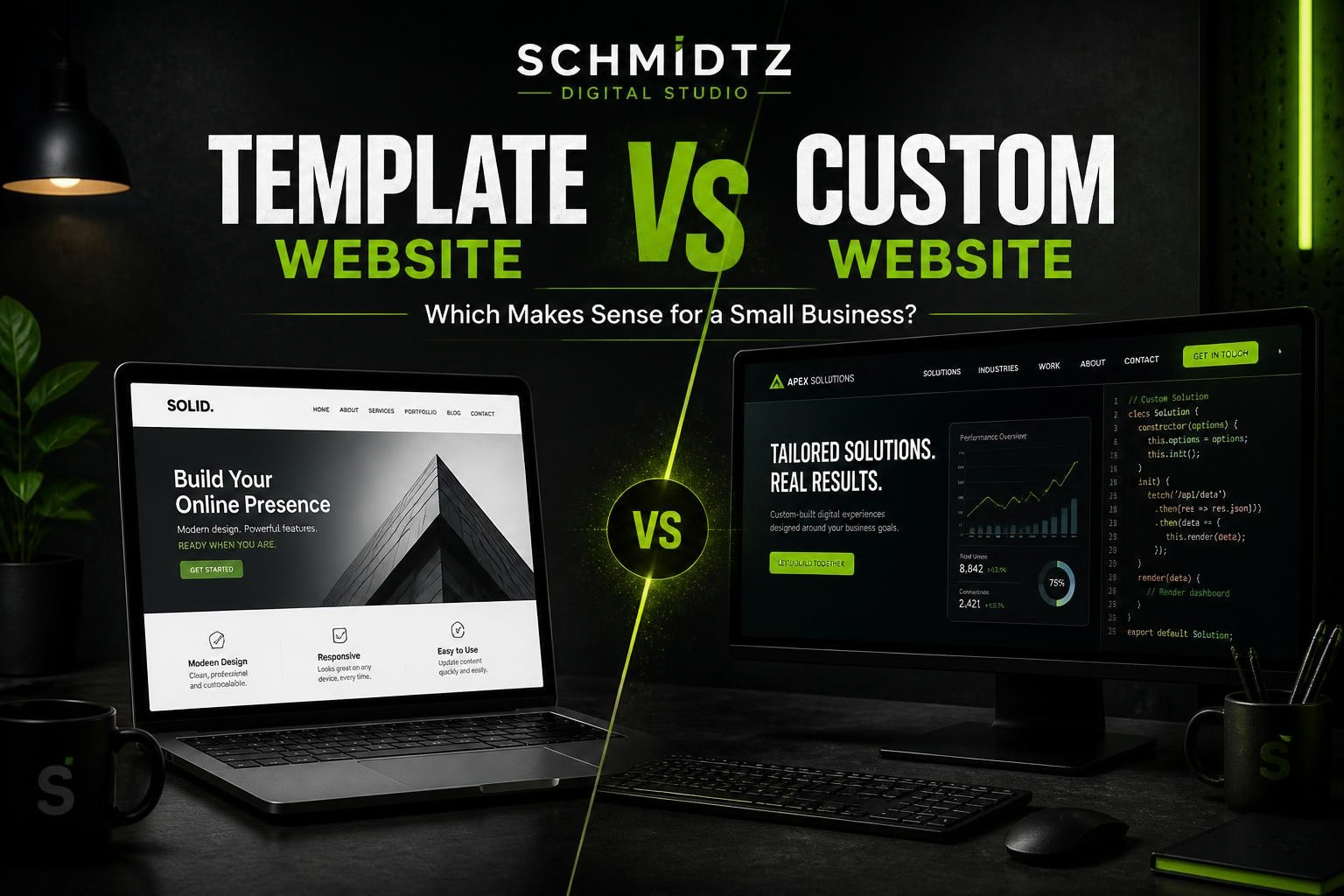
Choosing between a website template and a custom website is not really a question of which option is “better.” It is a question of which option fits the business, budget, timeline, and goals.
A good template can be the smartest choice for a small business that needs to launch quickly. A custom build can be the better investment when the website needs to support a unique workflow or grow into something more advanced.
What is a website template?
A website template is a pre-designed starting point. The layout, visual structure, and many interface components already exist. The business then replaces the demo content with its own branding, text, images, services, and contact details.
Templates can range from simple static websites to more complete systems that include dashboards, forms, booking tools, or business-specific features.
What is a custom website?
A custom website is planned and built around a specific business. Instead of adapting the business to an existing structure, the structure is designed around the business's goals, content, customers, and workflow.
Custom does not automatically mean enormous or expensive. It can be a focused five-page site, a specialized calculator, or a full web application. What makes it custom is that the solution is designed around the requirement rather than selected from a catalog.
Where templates make the most sense
Templates are especially useful when a business needs a professional web presence quickly and the core requirements are common: homepage, services, about information, contact form, testimonials, gallery, and basic lead generation.
- Lower starting cost
- Faster setup
- Proven page structure
- Easier preview before purchase
- Good fit for businesses with standard needs
A local service business, salon, creator, small community, or new side business may get everything it needs from the right template.
Where custom development makes the most sense
Custom development becomes more valuable when the website is expected to do work for the business, not just describe it.
- Unique booking or quoting logic
- Customer or employee dashboards
- Job and project tracking
- Custom calculators
- Special integrations
- Internal business tools
- Advanced reporting or workflow automation
If the business has to bend its process around the limitations of a template, that is often a sign that custom development deserves consideration.
Cost: template vs. custom
A template normally has a lower initial cost because much of the design and code already exists. Custom work costs more because planning, design, development, testing, revisions, and project-specific decisions take additional time.
But the cheapest initial option is not always the least expensive long term. A template that requires constant workarounds can eventually cost more in lost time and modifications than a focused custom solution.
Speed to launch
Templates usually win on speed. If the content, logo, images, and domain are ready, a well-chosen template can move from purchase to launch relatively quickly.
Custom work normally requires more discovery and testing. That extra time can be worthwhile when the project has business rules, data, user accounts, or custom workflows that need to be correct.
Flexibility and future growth
A template gives you the structure it was designed to provide. Many can be customized substantially, but there is usually a point where changing the template becomes more work than building the feature properly.
A custom site can be planned with future expansion in mind. That does not mean building every future feature today. It means avoiding decisions that make tomorrow unnecessarily difficult.
Ownership matters
Small businesses should understand what they actually own. Some hosted website builders lock the design and functionality inside the platform. Other templates provide source files that can be edited and hosted independently.
At SDS, we believe businesses should know what they are buying, what can be modified, and where the website can be deployed. If independence matters to you, ask those questions before committing to any platform or provider.
Maintenance and technical comfort
A template may be easier for a technically comfortable owner to edit, especially when the product includes clear documentation. A custom system may require more specialized maintenance depending on how much functionality it contains.
Neither model should be chosen without considering who will update the site after launch.
A hybrid approach can be the right answer
There is also a middle ground. A business can start with a strong template, customize the branding and content, and add a small number of targeted features. That can preserve much of the template's cost advantage while solving a few business-specific needs.
You can browse SDS website templates to see what a ready-made foundation can look like before deciding whether custom work is necessary.
How to choose
Choose a template when your needs are common, your timeline is short, your budget is limited, and a proven structure already fits the business.
Choose custom development when the website needs to support a unique process, integrate with other systems, provide advanced functionality, or become an important operational tool.
If you are still unsure, do not start with technology. Start with the business problem. Write down what visitors need to accomplish and what you need the website to do behind the scenes.
Need help deciding?
Use the SDS Project Discovery & Quote Request form to tell us what you are trying to build. We can look at the requirements and help determine whether a template, a customized template, or a custom solution makes the most sense.
Comments