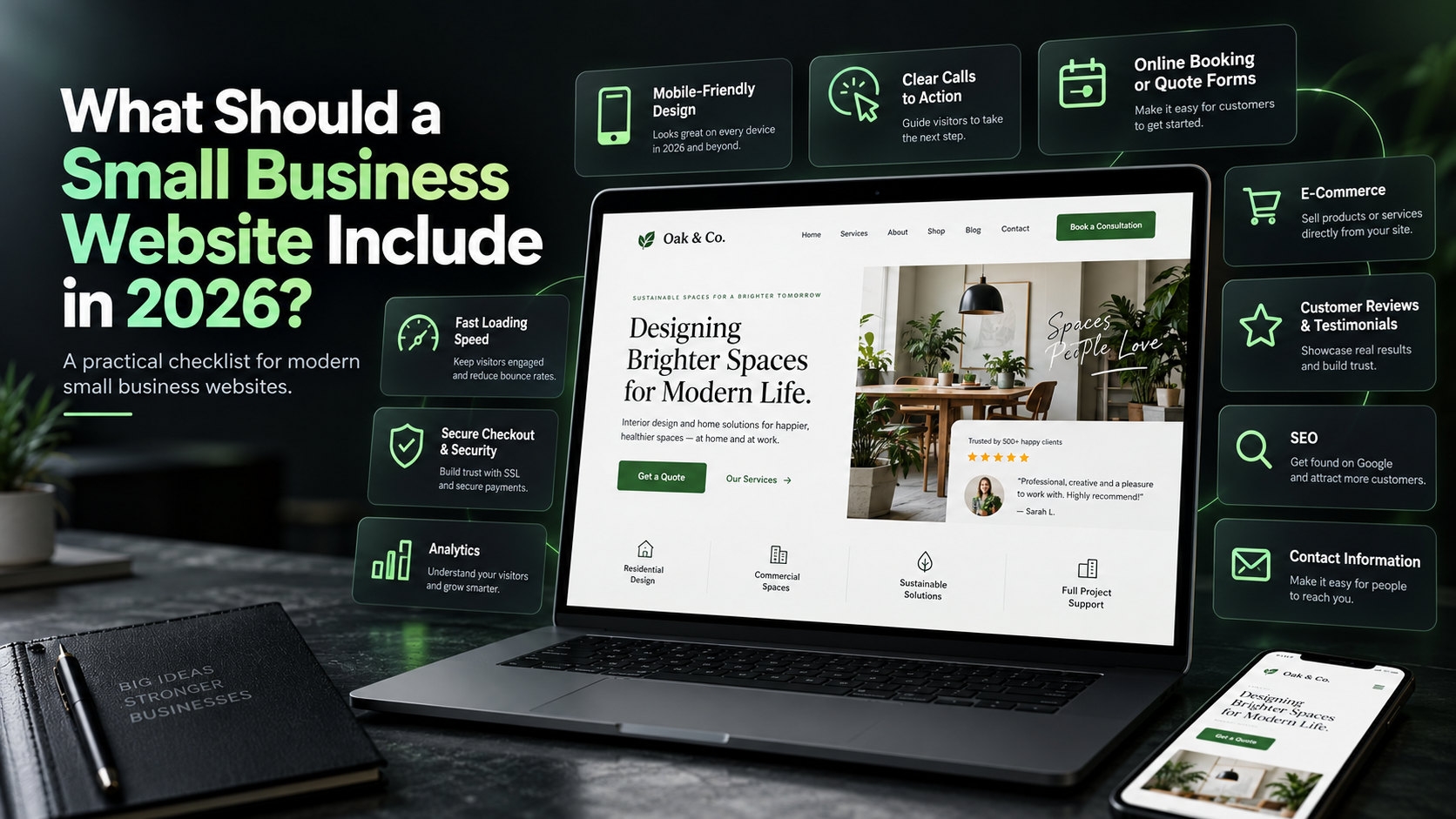
A small-business website should do more than prove that your company exists. It should help potential customers understand what you offer, decide whether they trust your business, find the information they need, and take the next step without unnecessary confusion.
That does not mean every business needs a huge website packed with complicated features. A contractor, cleaning company, salon, consultant, repair shop, photographer, and online seller can all need very different things. But strong business websites usually share the same foundation.
1. A homepage that explains the business quickly
Your homepage should answer three questions almost immediately: What does this business do? Who does it serve? What should the visitor do next?
A strong opening section normally includes a clear headline, a short explanation of the business, a useful visual, and one primary call to action. A cleaning company might lead with “Residential and Commercial Cleaning for Local Homes and Businesses” and follow it with a button to request a quote.
Clarity usually beats cleverness. Visitors should not have to decode a slogan before they understand what you sell.
2. Clear service or product information
One of the easiest ways to lose a potential customer is to be vague about what you actually offer. Depending on the business, this may mean individual service pages, product listings, pricing guidance, packages, examples of completed work, or FAQs.
The goal is not to answer every possible question on one page. The goal is to give visitors enough useful information to decide whether your business may be a fit.
3. A simple way to contact you
Contact information should be easy to find. Depending on the business, that may include a form, phone number, email address, hours, service area, address, booking link, or quote request.
For custom work, a detailed project form can be more useful than a generic “contact us” box. Asking about project type, desired features, timeline, budget, domain or hosting, and content readiness gives both sides a better starting point.
4. Mobile-friendly design
A business website needs to work comfortably on a phone. That means readable text, buttons that are easy to tap, navigation that does not fight the user, forms that fit the screen, properly sized images, and no horizontal scrolling.
Mobile visitors are often trying to act quickly. They may want a phone number, directions, a service description, a price range, or a quote form. If those tasks are difficult, the visitor may simply move on.
5. Strong calls to action
Every important page should give the visitor a logical next step. That might be Request a Quote, Schedule a Service, Browse Products, Try a Tool, View a Demo, or Start Your Project.
A call to action does not need to be aggressive. Its job is to remove uncertainty. The best CTA matches the page instead of repeating the same generic button everywhere.
6. Trust-building information
Before contacting a business, people usually want reassurance that it is legitimate and capable. Useful trust signals can include an About page, real business information, project examples, testimonials, before-and-after photos, clear policies, HTTPS, and a transparent explanation of how the process works.
You do not need dozens of reviews to build trust. Being specific, clear, and honest is often stronger than making broad claims such as “we are the best.”
7. Examples of your work
If your business creates, repairs, designs, or transforms something, show the result. Portfolios, screenshots, live demos, completed jobs, before-and-after photos, and case studies help people understand what they are buying.
For Schmidtz Digital Studio, a working demo can communicate far more than a paragraph saying that we build websites and business systems.
8. Frequently asked questions
If customers ask the same questions repeatedly, those questions belong on the website. Common examples include service areas, estimate policies, project timelines, deposits, hosting, payment options, revisions, and custom features.
A useful FAQ saves time for the business and removes friction for the customer.
9. Fast, reliable performance
A polished design loses value quickly if the site feels slow. Oversized images, unnecessary scripts, excessive animations, outdated code, weak hosting, and too many third-party resources can all hurt the experience.
Performance should be considered while the site is being built, not treated as a cleanup task after launch.
10. Basic search engine optimization
Search engines need clear signals about what each page is about. Good foundations include descriptive page titles, useful headings, readable URLs, strong page copy, relevant internal links, alt text, concise meta descriptions, and mobile usability.
SEO is not about repeating the same keyword until the page sounds unnatural. It is about making the page understandable and useful.
11. Helpful internal links
A visitor should be able to move naturally through the site. A blog article can lead to a related service, a service page can lead to a demo, and a planning guide can lead to a quote form. You can also connect people to useful online tools when those tools genuinely help with the task at hand.
12. Features that support the way the business actually works
Not every company needs custom software. But some businesses eventually need more than a brochure site. Useful features can include booking, quote management, customer accounts, job tracking, invoices, private dashboards, file uploads, calendars, or project-status tracking.
The best question is not “What advanced feature can we add?” It is “What problem can the website help solve?” When a business needs more than a basic site, custom web solutions can be built around the actual workflow.
13. Current and accurate information
A website should not be built once and forgotten. Services, prices, hours, employees, contact details, products, and policies change. Review important pages regularly and fix outdated information before customers find it.
A good small-business website has a job to do
The best website is not necessarily the one with the most pages, animations, or features. It is the one that helps visitors understand the business, build confidence, find the right information, and take the next step.
If you are planning a new site or a redesign, start with the problem the website needs to solve. Then build the pages and features around that purpose.
Planning a website for your business?
Schmidtz Digital Studio works with small businesses on websites, digital tools, templates, and custom solutions. If you are planning something new, our Project Discovery & Quote Request form collects the important details up front so we can understand the project before discussing a quote.
Comments