
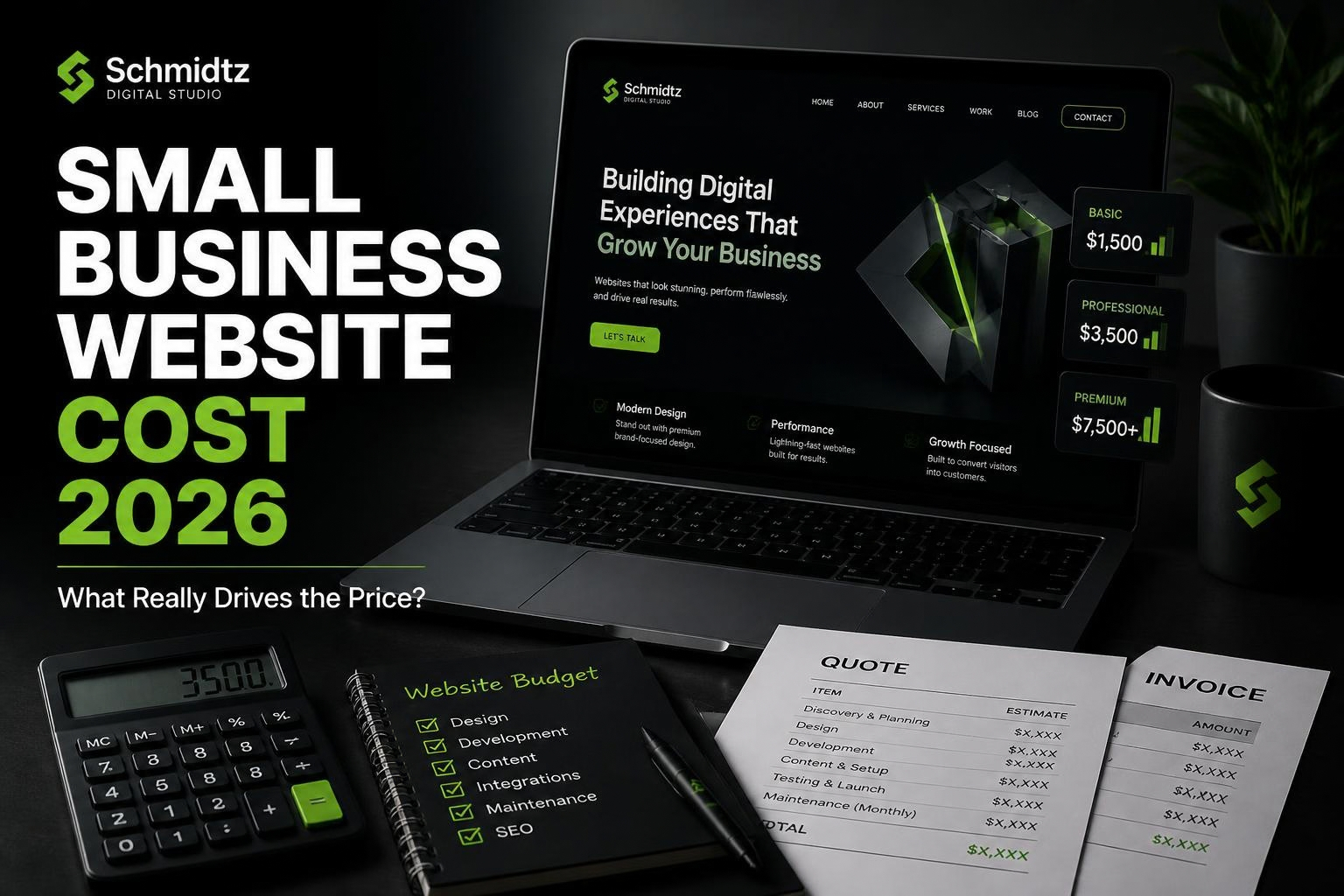
“How much does a website cost?” sounds like a simple question, but there is no single useful price without first understanding what the website needs to do.
A five-page informational site and a custom business system with accounts, scheduling, payments, and reporting are both “websites,” but they are not the same project. The better way to plan a budget is to understand the pieces that create the cost.
Start with the type of website
The biggest factor is the project itself. A small brochure-style website generally requires less design, development, and testing than an e-commerce store or web application.
Common categories include a basic business website, a customized template, an online store, a content-driven site, and a custom website or web application.
Templates can reduce the starting cost
A website template can reduce both design time and development time because the foundation already exists. That makes templates attractive to new businesses or companies whose needs match a common structure.
The final cost still depends on how much customization is needed. Replacing text and images is very different from redesigning half the layout or adding new application features.
Custom design and development cost more because more work is unique
Custom projects require discovery, planning, design decisions, development, testing, revisions, and launch preparation. When the site also includes business logic, databases, customer accounts, dashboards, or automation, the amount of project-specific work grows quickly.
That additional cost can be justified when the finished system saves time, reduces manual work, or supports revenue in a way a basic site cannot.
Page count matters, but not as much as page complexity
Ten simple informational pages can sometimes be easier to build than three highly interactive pages. When comparing quotes, ask what is included on each page instead of focusing only on the number of pages.
Content can affect the budget
A website still needs headlines, service descriptions, photos, product details, FAQs, policies, and calls to action. If the business already has polished content, the project can move faster. If the developer is also expected to organize, rewrite, source, or produce content, that work should be included in the scope.
Special features are often the biggest cost driver
Features such as booking, customer portals, employee management, quote workflows, online payments, file uploads, custom calculators, reporting, and third-party integrations require more development and testing than standard page content.
This is why two websites that look similar from the homepage can have very different project costs behind the scenes.
Do not forget domain, hosting, and ongoing costs
The build cost is only one part of website ownership. Depending on the setup, you may also pay for a domain name, hosting, email, paid integrations, transaction fees, backups, maintenance, or future updates.
A good quote should make it clear which costs are one-time and which costs may continue after launch.
Beware of unusually cheap quotes
A low price is not automatically a bad deal, especially when the scope is small or a template is being used. But make sure you understand what is missing. Does the price include mobile testing, forms, basic SEO setup, revisions, launch help, source files, and support?
Saving money at the beginning is not helpful if the site must be rebuilt six months later.
Beware of paying for complexity you do not need
The opposite problem also exists. A small business should not be sold a large custom system simply because custom development is available.
If a clean, focused site with a quote form solves the problem, that may be the right project. Technology should support the business instead of adding unnecessary overhead.
How to create a realistic website budget
Before requesting quotes, write down your must-have features, nice-to-have features, target launch date, content readiness, and what you want customers to do on the site. Then decide what you can reasonably invest without putting pressure on the rest of the business.
That information lets a developer suggest tradeoffs instead of guessing.
Think about value, not just price
A website should have a business purpose. If it helps a service company capture qualified leads, reduces time spent answering repetitive questions, allows customers to schedule themselves, or supports product sales, the value may be much larger than the initial build price.
Our business calculators and web tools are examples of the same principle on a smaller scale: useful technology should make a decision easier or a task faster.
Get a quote based on the actual project
The most useful website quote is based on requirements, not a guess. SDS uses a Project Discovery & Quote Request form to collect the important details before pricing a custom project. That lets us understand what the website needs to accomplish and suggest a practical path forward.
Comments