
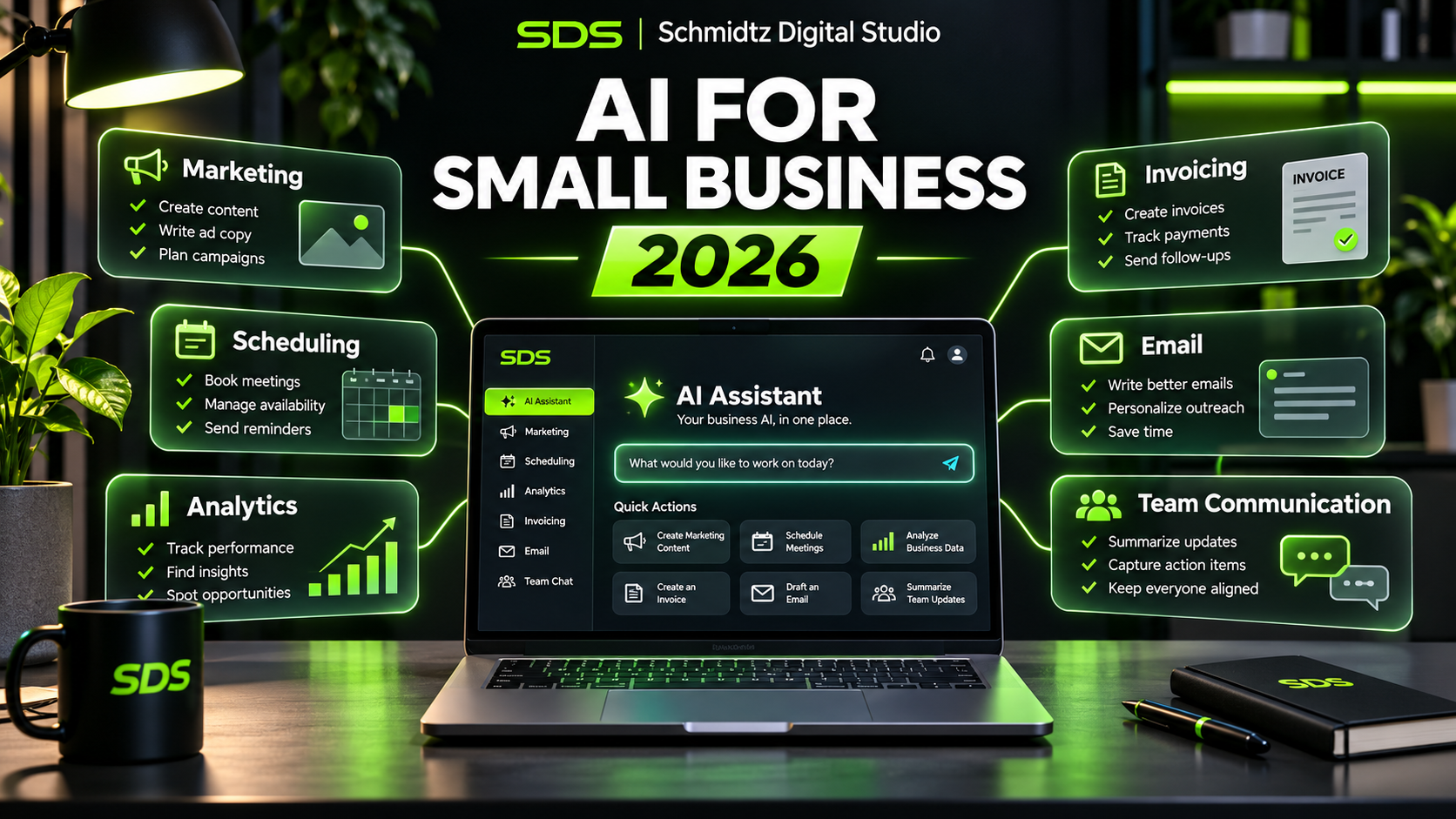
Artificial intelligence is no longer something only large technology companies are experimenting with.
In 2026, small businesses are using AI to draft marketing content, organize information, assist with customer communication, and simplify everyday work.
But what does that actually look like for a local repair shop, cleaning business, independent retailer, or someone running a company from home?
The answer is more practical than the headlines might suggest.
Most businesses aren't building futuristic robots or replacing their entire workforce. They're finding smaller ways to make difficult or repetitive tasks easier.
AI Adoption Is Growing Among Small Businesses
According to the U.S. Chamber of Commerce's October 2026 Empowering Small Business report, 66% of surveyed U.S. small businesses reported using artificial intelligence. That compares with 23% in 2023.
That's a significant change in just three years.
However, using AI doesn't necessarily mean a company has completely automated its operations.
A business might use an AI assistant several times a week to write emails, prepare advertising ideas, or organize notes. Another might use accounting software with built-in AI features without thinking of itself as an AI-powered business.
Different surveys also measure AI adoption differently, so their percentages won't always match.
The important takeaway is that AI is becoming part of ordinary business software and everyday work.
1. Creating Marketing and Social Media Content
One of the most common uses of AI is marketing.
Small-business owners often handle their own Facebook posts, promotional announcements, email newsletters, and product descriptions.
Creating all that content takes time, particularly when the owner is also answering customers, managing appointments, and doing the actual work.
AI can help with early drafts and brainstorming.
For example: A local cleaning business is preparing a holiday promotion. The owner could ask an AI assistant to suggest five friendly Facebook post ideas, write a short promotional announcement, and create several headline options.
The owner then chooses the strongest ideas, checks the details, and adjusts the wording to match the business.
AI can help with the writing process, but it shouldn't decide the business's identity.
Brand colors, recognizable graphics, accurate offers, and a consistent voice still matter.
2. Handling Repetitive Customer Communication
Think about how many times a business answers similar questions.
What are your hours? Do you offer estimates? How do appointments work? What areas do you serve?
AI can help organize those answers into useful FAQs, email templates, and customer-service drafts.
Some businesses also use AI-assisted chat systems to respond to routine questions.
However, businesses need to be careful about what those systems promise.
An AI assistant that invents a price, promises an unavailable appointment, or misinterprets a customer's problem can create more work than it saves.
A safer approach is to start with draft responses based on verified business information, keeping a person responsible for unusual or important questions.
3. Organizing Administrative Work
Running a small business involves more paperwork than many people expect.
There are appointments to schedule, estimates to prepare, messages to answer, inventory to organize, and records to review.
AI can assist with tasks such as:
Turning rough notes into an organized checklist
Drafting meeting summaries and follow-up emails
Creating templates for common business documents
Organizing non-sensitive information into categories
Suggesting ways to simplify repetitive workflows
Imagine a computer repair business that records basic diagnostic notes after each job.
An AI tool could help turn those notes into a clearly written customer summary.
The technician would still need to verify the diagnosis and confirm what work was completed.
That's an important distinction: AI can help explain the work, but it shouldn't invent work that never happened.
4. Helping With Research and Business Planning
Small-business owners regularly make decisions about products, equipment, pricing, and expansion.
AI can be useful for exploring possible options.
For example, an owner might ask for a comparison checklist before purchasing refurbished computers for resale or request help identifying expenses that should be included when estimating the cost of a service.
AI can also help brainstorm questions to investigate before launching a new product.
But there is a catch.
AI-generated research can contain outdated information, incorrect calculations, or sources that don't support the claim being made.
Important prices, product specifications, legal requirements, and financial figures should always be checked against trustworthy sources.
Think of AI as a research assistant—not the final authority.
5. Assisting With Bookkeeping and Financial Workflows
Artificial intelligence is also appearing in accounting and financial software.
Some tools help categorize transactions, identify unusual patterns, process documents, or summarize financial information.
For a business owner, that can reduce some of the effort involved in keeping records organized.
However, financial work requires accuracy.
A transaction categorized incorrectly could affect a report. A mistaken projection could influence a purchasing decision.
Business owners should review AI-generated financial results carefully and use appropriate accounting or tax professionals when necessary.
AI can make financial information easier to understand, but it doesn't remove the responsibility to keep accurate records.
What Does the Research Say About Results?
The 2026 Federal Reserve Small Business Credit Survey report provides a useful perspective.
Among surveyed employer firms using AI, 71% reported increased productivity, 39% reported improved quality of goods or services, and 31% reported higher sales.
Those figures are encouraging, but they describe businesses' reported experiences. They don't prove AI caused every improvement or guarantee the same results for another company.
The same report identified accuracy as a leading challenge among AI users.
In other words, AI can be helpful, but it still needs oversight.
The Risks Small Businesses Should Understand
AI isn't perfect, and adopting it without safeguards can create problems.
Incorrect information: AI can produce convincing explanations that contain mistakes.
Customer privacy: Owners should avoid entering private customer records, passwords, financial details, or confidential business information into unapproved tools.
Generic content: Publishing AI-generated marketing without editing can make a business sound like everyone else.
Overreliance: Employees and owners still need to understand the work being performed.
Unexpected costs: A collection of AI subscriptions can become another business expense without delivering enough value.
The goal should never be to use AI simply because it's popular.
It should solve a real problem.
How to Start Using AI Without Overcomplicating Things
If you're curious about AI but haven't found a practical use for it, start small.
First, identify one repetitive task.
Maybe you spend too much time writing announcements, preparing customer emails, or organizing notes.
Next, choose a tool appropriate for that task and read its privacy settings.
Test it using non-sensitive information.
Compare the results against your usual process. Did it save time? Was the information accurate? Did you spend so long correcting mistakes that the tool provided little benefit?
If it genuinely helps, make it part of your workflow.
If it doesn't, move on.
You don't need a dozen subscriptions or an elaborate automation system to benefit from technology.
Sometimes one useful tool is enough.
Will AI Replace Small-Business Owners and Employees?
AI will continue changing how work gets done, but replacing people is not the same as helping people work more efficiently.
A computer technician still needs to diagnose hardware correctly.
A graphic designer still needs to understand the customer's brand and visual goals.
A cleaning company still needs people to perform the service.
AI can support planning, communication, and administrative tasks around that work.
The strongest results often come from combining technology with human judgment, experience, and accountability.
Final Thoughts: Use AI With a Purpose
Artificial intelligence is becoming a practical part of running a small business.
Whether it's drafting content, organizing notes, assisting with customer questions, or simplifying administrative tasks, the technology has useful applications.
But successful adoption isn't measured by how many AI tools a business uses.
It's measured by whether those tools make the business more effective.
At Schmidtz Digital Studio, we believe technology should solve real problems and make everyday work easier.
That's why we focus on practical digital tools, creative design, and software built around the people who use it.
AI is another tool in that larger picture.
Use it thoughtfully. Check its work. Protect your information. And never lose the human judgment that makes your business your own.
Sources and Further Reading
U.S. Chamber of Commerce — 2026 Empowering Small Business Report (October 2, 2026): https://www.uschamber.com/technology/2026-empowering-small-business-report
Federal Reserve Banks — 2026 Report on Employer Firms: https://www.fedsmallbusiness.org/survey/2026-report-on-employer-firms
Federal Reserve Bank of San Francisco — AI Adoption Among Small Businesses (July 15, 2026): https://www.frbsf.org/research-and-insights/publications/community-development-research-briefs/2026/07/ai-adoption-in-small-businesses-2024-sbcs/
Intuit QuickBooks — 2026 AI Impact Report: https://digitalasset.intuit.com/render/content/dam/intuit/sbseg/en_us/Blog/Downloadable-assset/2026-ai-impact-report.pdf
Comments